Best Podcast Format? Easiest, Popular, & Most Sustainable Options
Podcast formats are like little roadmaps for your episodes. They’re the framework you build your content on, and the way you deliver it to your audience for maximum impact. There’s no single best podcast format. But, podcasts do tend to boil down to one of six typical methods. Let’s decide which is the one for you!
What Are the Best Podcast Formats?
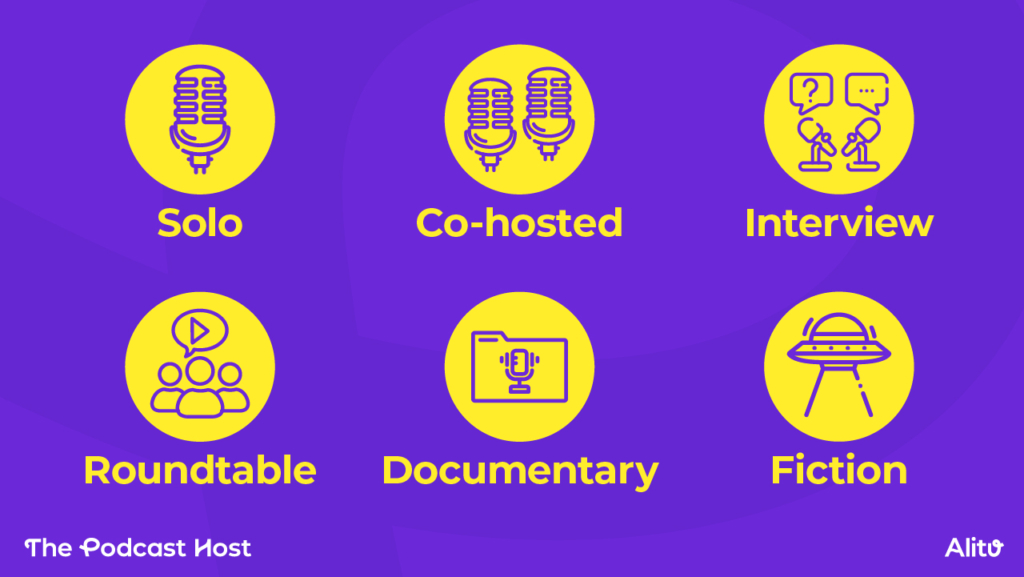
- Solo: flying on your own
- Co-hosting: working with a partner
- Interview Podcast: new guest every week
- Roundtable: wider panel of guests
- Documentary: highly produced content mix
- Fiction: telling a story
How Do I Choose a Podcast Format?
Like many other decisions you make when starting a podcast, this can cause some decision paralysis. After all, what if you mess up and choose the wrong podcast format!?
But any podcast format is like a good coat. Over your podcasting life, you’ll try on every type. You’ll find one that fits like a glove, that just seems right, and you’ll wear it for a while. But then, as the seasons turn, you’ll find yourself hankering for another.
Your podcast format changes over time, and it should, depending on your listener feedback.
So, the secret is to experiment in the early days. Try a few different methods over your first 20 episodes. See which ones resonate, and which ones best fit your personality and schedule.
Even later in your show, feel free to mix it up a little from time to time. Experiment and ask your podcast listeners what they think. That’s the driver for change and innovation in your show, and that’s what keeps people interested. Alongside amazing content, of course!
Types of Podcasts by Format
So, what are your options? Let’s take a look at the most common podcast formats, along with some real-world examples and a few recording considerations.
1. The Solo Podcast Format
Just a podcaster and a microphone. With the solo format, you talk directly to your audience. This format means you only ever need to rely on yourself. But it can also be quite intimidating for the podcasting beginner.
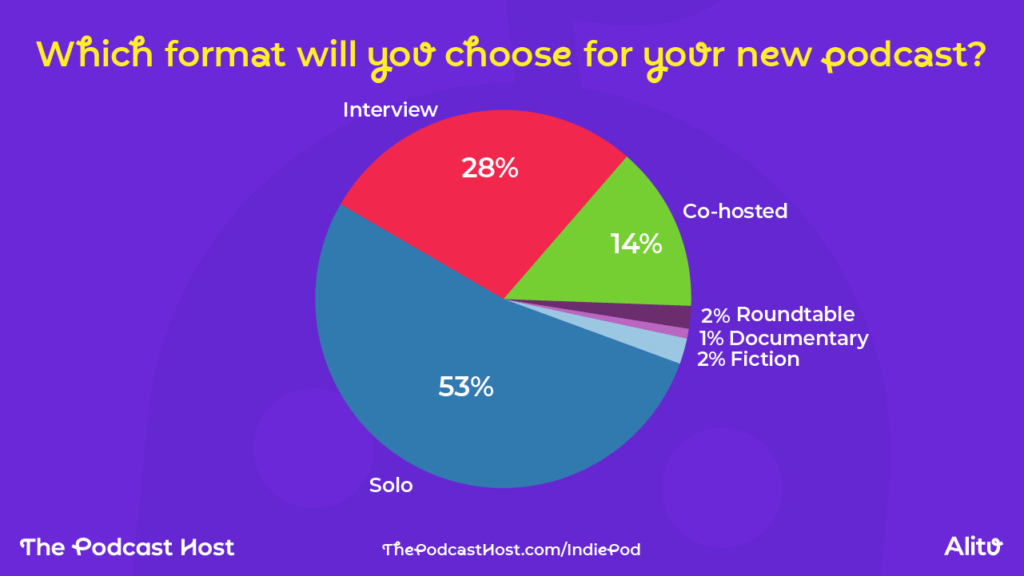
That said, it’s the most popular podcast format amongst aspiring creators. According to data from the Independent Podcaster Report, 53% of aspiring creators said they plan to do it alone and take a single-host approach.
Recording Solo Podcasts
Solo podcasts are by far the easiest to record. A typical setup will be a podcaster recording with a USB mic into Audacity, which is free.
Some solo podcasters prefer to use their smartphones and will even record episodes while out walking. If you do this, it’s a good idea to add a wireless lavalier mic to improve your audio quality.
If you choose to do video, then OBS Studio is a popular free software option. You could also opt for a tool like Alitu, which is more podcast-specific and includes a suite of editing and publishing tools.
Solo Podcast Example: Dan Carlin’s Hardcore History
Dan’s Hardcore History podcast is loooooooong (3hrs+ per episode), in-depth and just him. No FX, no fanciness, just one bit of intro music and his voice. But somehow, he makes it really, really engaging. It’s the perfect example of amazing scripting.
2. The Co-Hosted Podcast Format
Enlisting a pal to be your ongoing co-host can really breathe life into your episodes. There are potential downsides, though, as always. You’ll now be reliant on someone else, which means scheduling recording times that suit both. With a co-hosted format, there also needs to be a conversation about the ownership of the podcast. How will any income be split if you’re fortunate enough to start making money, for example?
Co-Hosted Podcast Example: Boagworld
Boagworld is a web design show hosted by the two co-founders of an agency, Paul Boag and Marcus Lillington.
It shows how co-hosting can work really well to showcase personality and produce an engaging experience. The banter and back-and-forth between Paul and Marcus is hilarious to listen to, and the question-and-answer format adds to the show’s depth.
In terms of recording with a co-host, the same rules apply when working with interview guests, so we’ll get to that in the next section.
3. The Interview Podcast Format
If you’re passionate about a topic and have a thirst and curiosity for going deeper, why not interview folks in that space?
Interview podcasts are ultra-popular. When done well, they can create consistently fresh content and offer a diverse range of perspectives.
Again, though, this podcast format isn’t without its challenges. The interviewer might not be seen as “the expert” (if that’s your goal), and constant scheduling and finding guests become the order of the day. Interviewing is also a skill you’ll need to hone and prep. And, no matter how good you get, you’re still heavily reliant on your interviewee’s performance on the day.
Interview Podcast Example: Board Game Design Lab
The Board Game Design Lab does exactly what it says on the tin. Host Gabe Barrett speaks with game designers and industry folks of all backgrounds and levels, and expertly draws out the value from these conversations in a natural, chatty way. We were so impressed by Gabe’s podcast that we invited him to be part of our IndiePod Legends season on Podcraft.
Recording Podcasts With Guests or Co-Hosts
As mentioned, the setups are the same in principle whether the person recording with you is an ongoing co-host or a one-off guest.
There are two ways these podcast formats are recorded – in-person, or remotely online.
In-Person
This is where you’re in the same room together. Maybe you’re even on the same sofa. It isn’t always practical or possible, but if you can manage it, it can 10x the conversational dynamics and chemistry.
In this situation, participants should always have their own mics. A good-sounding, affordable setup would be something like two Samson Q2U mics running into a Focusrite Vocaster 2 USB audio interface.
On the software front, you could use Audacity if you’re purely focused on audio, or OBS if you want to record the video, too. Again, Alitu will give you much more podcast-specific tools and options on both fronts.
In-person chats can also work well with a smartphone lavalier setup, like the Rode Wireless Micro or BOYA Mini. This also frees you up to ditch the couch and head out on a walk together!
Remotely
Getting together in-person can simply be impossible in many cases. Your guest or co-host might be thousands of miles away. Fortunately, sophisticated remote recording tools can make it sound like you’re in the same room together.
In this situation, your equipment is pretty much the same as if you were recording solo. A USB mic or a microphone plugged in via a USB audio interface will do the trick at your end. Your guest or co-host will need a similar setup.
There are loads of brilliant remote recording software options out there these days. A tool like Alitu, for example, will record in video or audio in a ‘double-ender’ method that protects the quality from unstable WiFi connections, and it has everything you need to edit and produce the episode, too!
4. The Roundtable Podcast Format
A roundtable refers to the idea of getting a handful of folks together to discuss a set topic. Usually, there would be at least one regular host, if not two or three. Then the rest of the ‘table’ is made up of guests who are experts in the topic at hand.
The host or hosts will direct the roundtable, asking questions and steering the discussion so that everyone gets a turn and contributes to a great conversation.
Roundtables can be a great way to build authority in your niche, allowing you to invite prominent guests to the show and produce great content from their experience. Most of the logistics are very simple – editing, content planning, etc – but organising guests in the early days can be hard.
Roundtable Podcast Example: The Podcasters’ Roundtable
The Podcasters’ Roundtable has been inactive for a few years now, but the show, chaired by the legendary podcaster Ray Ortega, was a real masterclass in this podcast format. In a typical episode, Ray would be joined by 3-5 ongoing co-hosts and first-time guests, and they would dive deep into the chosen topic of the day.
Recording Roundtable Podcasts
It’s logistically unlikely you’d be recording a roundtable in-person, with participants gathered around a real table (even a round one!). But… if you’re lucky enough to pull it off, everyone will need their own mic, and I’d hook them up to a digital recorder like the Zoom H6, Zoom PodTrak P4, or Rode Rodecaster II.
If you’re running your roundtable remotely, then it’s just like speaking to a guest or co-host online, except there are more of them. A tool like Alitu, Riverside, or Zencastr will handle this seamlessly.
5. The Documentary Podcast Format
Often referred to as “BBC-style” or “NPR-style”, the documentary brings in multiple voices, musical elements, and actuality to add an extra layer of production and storytelling. The end product can sound great, but the time and work needed to put them together will increase drastically.
Documentary Podcast Example: The Startup Podcast
One of my favourite shows, the Startup Podcast, is a really transparent look behind the scenes of starting up a business. Season 1 followed the founding of Gimlet Media, the show’s producers, and they’ve moved on to other companies since.
This podcast format takes a lot more time to create and edit, but produces a much more engaging, high-quality product. Again, not for everyone, though. Especially if you’re brand new to podcasting.
Recording a Documentary Podcast
There are a lot of moving parts here, and documentary podcasts are recorded in increments, rather than in one single session. This will typically involve a blend of the formats we’ve covered so far.
Before you start recording, you should have a plan in place to determine the purpose, narrative, and hook. Making a documentary is a huge subject in its own right. Check out our guide for a range of tips, tactics, and tools. I would also thoroughly recommend a book called Out on the Wire by Jessica Abel. An audio storytelling masterclass by one of the best in the business!
6. The Fiction Podcast Format
They say everyone has at least one good book in them, but fiction podcasting is the new novel writing. Fiction podcasts come in many forms, from “audiobook style” to fully soundscaped audio drama where every footstep is accounted for. Here’s our best fiction podcasts roundup if this is a world you’d like to dive into.
Fiction Podcast Example: Campfire Radio Theater
Campfire Radio Theater is an immersive audio drama horror podcast. It’s an anthology series mixing dark myths and legends with original stories. The recurring theme is the outstanding production level, with music and sound effects that build an entire movie in your ears!
Recording a Fiction Podcast
If you’re writing and reading your fiction, then we can roll out that easy USB mic-Audacity combo. But if you want to bring in multiple voices, then you can use the tips from the roundtable section to help record your cast. Just like docupods, producing an audio drama is a huge subject in its own right, so check out the linked guide if you’d like a deeper dive.
Podcast Formats: FAQ
Okay, now that we’ve covered the six common podcast format options, you’ll hopefully have a clearer picture of which direction you’d like to take. But, there’s every chance you still have a few burning questions before you head off to plan that first episode. Here are a few of the most frequent podcast format questions we get asked.
Which Podcast Format Will Get Me the Biggest Audience?
There is no silver bullet podcast format for growth. If you took a bunch of successful podcasts, you’d find that they came in various formats, shapes, and sizes. Just like podcast topics and subject matter (where we’re often told that true crime podcasts have the best chance of success), this misses the point of what makes a show prosperous. A big part of that is your passion, enthusiasm, and reason for showing up consistently behind the mic.
And, speaking of consistency, we need to keep things as sustainable as possible, so…
Which Podcast Format Has the Least Editing & Production Time?
The more time you can spend on your content, the better. But that doesn’t necessarily mean hours in front of your podcast editing software. Bite off more than you can chew, and you’ll soon burn out and give up.
Unsurprisingly, solo podcasts are the most efficient when it comes to editing and production. On the flip side, fictional podcasts, documentaries, and roundtable or panel podcast formats can really start to eat up the hours.
With the right tools and planning, though, you can make any podcast format sustainable. Pair up the Podcast Planner Journal with podcast-maker tool Alitu to give you productivity superpowers.
Alitu has everything you need to record, edit, and publish your podcast, from call and solo recording and automatic production to slick, intuitive editing tools, and built-in hosting. That’s all under one login and subscription, too, so you save money as well as time!
Should Every Podcast Episode Follow the Same Format?
It’s your podcast, and you’re the boss. If you’ve been doing interviews but fancy testing out the solo podcast format, go for it. Whilst it’s arguably better that your listeners know what to expect, the most important thing is that you have the time and enthusiasm to keep publishing new episodes. So, if you take one thing away from this post, it’s don’t be afraid to mix things up!
Summary: Choosing a Podcast Format
Aspiring podcasters can suffer from decision paralysis when choosing their podcast format. But this isn’t something you need to nail perfectly the first time.
Perhaps you’ll launch with a solo show, test out some interviews, and find that you really enjoy them. Maybe you’ll start with the interviews, but relish the freedom of flying solo.
Your podcast can change and adapt over time. Or, you might learn the ropes with your first show, then launch an entire podcast series on a new topic with the format you know works best for you.
Choosing a format is just one aspect of starting a podcast, so be sure to check out our pillar guide for deeper tips on nailing your topic and target listener, right through to growing your audience and monetising your show!